D Flip-Flop with Reset
📌 Introduction
This note compares two common D flip-flop designs — one with an asynchronous reset and one with a synchronous reset.
-
Asynchronous reset: The output
qis immediately cleared to0when the reset signal is asserted, regardless of the clock.
This is often used for global power-on reset circuits. -
Synchronous reset: The reset only takes effect on the clock’s rising edge.
It avoids metastability issues during reset release and is more suitable for synthesis and timing control.
| Type | Sensitivity List | Reset Timing | Typical Use |
|---|---|---|---|
| Asynchronous Reset | @(posedge clk or posedge ar) |
Immediate | Power-on reset, quick fault recovery |
| Synchronous Reset | @(posedge clk) |
On next clock edge | Regular sequential logic, easier STA |
🧑💻 Code Example
Asynchronous Reset DFF
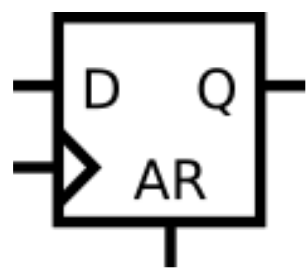
module top_module (
    input clk,
    input d,
    input ar,   // asynchronous reset
    output q);

    always @(posedge clk, posedge ar) begin
        if (ar)
            q<=1'b0;
        else
            q<=d;
    end
endmodule
Synchronous Reset DFF
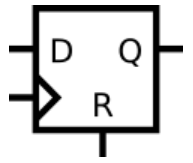
module top_module (
    input clk,
    input d,
    input r,   // synchronous reset
    output q);

    always @(posedge clk) begin
        if (r)
            q<=1'b0;
        else
            q<=d;
    end

endmodule